


Commissioners recognize Lady Musketeers, discuss government transparency

Last week’s April 21 Commissioners Meeting covered topics such as an official recognition of achievement for the Eastern Musketeers Girls Basketball Team for winning the 2026 IHSAA Class 2A Girls Basketball State Tournament, as well as more discussion regarding transparency on topics like READI grants and the Highway Garage Project.

The meeting began with the recognition of the Eastern Musketeers. Commissioner Todd Ewen read the resolution aloud:
Resolution 2026-01: Resolution of the Board of Commissioners of Washington County, Indiana. Recognizing and honoring as champions the 2026 Eastern High School Lady Musketeers Basketball Team.
“Whereas, the Board of Commissioners of Washington County, Indiana, recognizes the merit and value of lessons learned and accomplishments achieved by its youth through sports. And Whereas, success in sports, like success in life, results from a combination of hard work, intensity, desire, teamwork, support from peers and families, support from community, and the grace of God. Whereas, the Eastern High School Lady Musketeers achieved success by obtaining the 2026 State 2A Basketball Championship. Whereas, the Board of Commissioners of Washington County, Indiana, formally wishes to recognize the special combination of the virtues achieved by these players, along with their coaches and families, and to express the pride that Washington County has in them for their accomplishments as a team. Therefore, be it resolved by the Board of Commissioners, Washington County, Indiana that the 2026 Eastern High School Lady Musketeers basketball team comprised of the following members:
Bailey Trainor
Abigail Fowler
Sidney Burton
Allie Johanningsmeier
Addison Smith
Katherine Hauner
Avery Smith
Bailee Robbins
Emma Brawner
Ashton Johanningsmeier
Eliza Starrett
Brooke Schear
Sophia Gibson
Assistant Coach Michael Batt
Assistant Coach Madeline Lewellen
Assistant Coach Jennifer Morris
Head Coach Taylor Drury

“These ladies should not only be recognized for their athletic achievements this past basketball season, but honored along with their families for the thrills they brought us as fans, the example they set by their virtues, hard work, intensity, persistence, sportsmanship and teamwork, and for the pride they have given all of us in Washington County, Indiana. For all these things, we recognize their achievements and today pronounce them champions.”
Following the reading of this resolution, the meeting pivoted to the public comment portion. Jennifer Bowers approached to ask about Regional Economic Acceleration and Development Initiative (READI) grant funds and how they are utilized.
“I'm here this morning because I would like to ask how the county decides projects for READI and other grant funds, specifically the 4-H building,” said Bowers. “I've been through the old minutes, and there's been very little disclosed from this body or the county council. However, I received documents that show, as of March, we've been approved to receive money. Way more than what was ever discussed. As of March of 2026. The READI funds have approved us for $1.2 million on a $1.7 million project. I would like to know how we got there. How does this county even determine what projects are going to be submitted for ready funding? That's never discussed at these meetings.”

“Back in 2023 or 2024, if you're familiar with the RDA (Regional Development Authority) and how that works…” began Commissioner Todd Ewen. Bowers stated that she was not familiar.
“It's funded by the Indiana Economic Development Corporation (IEDC),” Ewen said. “When the state has excess funds, they created these regional development authorities, which we joined back in 2017 or 2018. Five counties [joined] Clark, Floyd, Madison, Washington and Scott. There's a five member board. One delegate from each county represents the RDA. They hold monthly meetings. Have you ever been to a meeting?”
“I have not, but my understanding is this county has representation at that,” replied Bowers. “That's also part of my question. Why does that person or persons – because there are several people from this county that sit on these different boards, but they do not come to these meetings to tell us what's going on and where we are.”
“Probably because there’s not much going on,” Ewen said.
Bowers said, “we beg to differ,” which prompted Ewen to “go through the whole thing,” so Bowers “won’t have to be asking question after question.”
“The RDA have these meetings; they came around to site visits,” Ewen said. “We had several projects that we submitted. If the mayor was here, he could tell you that you submit projects, and sometimes you get the money, sometimes you don't. There were several things that we were turned down on. We asked them for help for the new Highway Department project. They said they were trying to steer clear of things like this. They wanted to focus more on child care, housing, youth development type things. We submitted repair of our sidewalks out here because we're kind of getting a little shabby. We were turned down on that. We also submitted a new 4-H building. That went through. They did approve that. We have to match the $1.2 million with about $300,000 or $400,000, and those matches can be achieved in kind. In other words, for instance the mayor helped us out here, part of the match was trying to get rid of the old pool because it was basically found out there was a sinkhole in it. It wasn't safe. It was going to cost too much to repair it. That's with the help of the mayor that was used as match money. So, the project is still in limbo.
“I believe a year ago, in March or February, your husband [Wes Bowers] came to a meeting and asked about the bidding process on these projects,” Ewen continued. “It's not been put out for bid yet. At that time, we told him that bids would be released in June. That was in 2025. What happened was there was an election. We got a new governor. The governor wanted to put all these projects under a microscope, so he decided to take our tax dollars and do a forensic audit of all these projects. So, instead of starting this project back last year when we would have liked to, it's been delayed and it's basically a year behind schedule. So, the final approval will be going through the forensic audit by the Ernst and Young accounting firm, along with the IEDC, probably in the next couple of months. Hopefully we can get started on it after the fair this year. And this was discussed in several meetings. And this is kind of where we're at now. We're just waiting on the state.”
“Have we, as commissioners, ever approved this project?” asked Commissioner Tony Cardwell. To which Commissioner Ewen replied, “not since you’ve been here.”
“I don’t think it was approved prior to that, too. I’ve pretty much kept up with things,” Cardwell said.
“It was approved,” Ewen replied.
“I'd like to see the minutes of the meeting where it got approved,” said Cardwell. “I'm not against it by no means, but once again, following proper procedures would pretty much clear up a lot of the issues we have here.”
Ewen then asked Bowers if she was opposed to the project.
“No, sir. I don’t understand how we got here though,” she said.
“It was approved; we submitted a grant,” Ewen said. To which Bowers asked, “who is ‘we’?”
“The county as a whole,” said Ewen.
“But it comes from a specific entity. So what entity submitted it?” Bowers asked.
“Everyone was aware of this,” said Ewen.
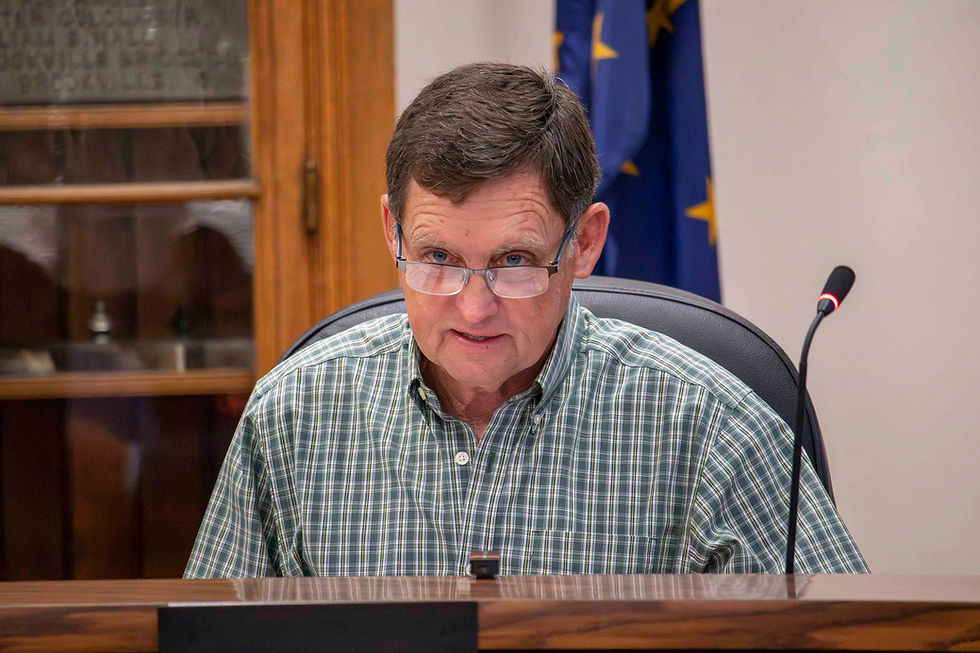
“I don't know how everyone was aware of this,” Bowers said. “I've been through the old minutes, so I have a timeline of what was said in these meetings, and Tony is correct, it was never actually asked, ‘do we want to do this?’ It was just said, ‘this is what we are doing.’ So, according to the documents, the original submission was for $358,000 total build. The READI request was $286,000, leaving the county short $71,000. As of March 20th of 2026, the total cost is now $1,756,058. The grant is $1.2 million. That leaves a difference of $556,000 for this county to come up with.”
“That’s right, and we’ve already set–” began Ewen.
“But none of that's been discussed here,” she said. “That's my question. Who talks about this? It's not been discussed at a council meeting.”
“It was discussed at a council meeting,” he said. “We set aside [funds] out of our investments. This has been over a year ago. I can pull up the minutes. A council meeting, I was here and I requested $300,000 with a signature page from the treasurer releasing the funds to make them available. They've been sitting in the general fund for over a year. It's in the council minutes.”
“Yes, you're right. $300,000, but we're short $556,000,” she replied.
“The rest of the matching funds are going to be in-kind payment,” What the mayor did to do the demolition of the old pool–” said Ewen.
“Which was about $42,000,” Bowers said.
“There are several things,” he said. “There's going to be a little paving, we've got to do some sewer upgrades, which we're going to pay out of EDIT (Economic Development Income Tax) funds. That is going to be probably around $30,000. We're going to do some electrical upgrades, which I spoke with the contractor–”
“Who approved that stuff, Todd? I think that’s what she’s asking,” Cardwell said. “What you’re talking about – doing all this other work – who approved that?”
“We have,” Ewen replied.
“Who is ‘we’?” asked Bowers.
“The commissioners. We have,” said Ewen.
“That’s not in any of the minutes,” Bowers said.
“There are day-to-day things that go on in this county, maintenance wise, that are not brought up in public meetings because they need attention pretty quickly,” he replied. “Repair work, things like that.”

“Okay, but we went from a project that started out at $358,000 to now $1.7 million. That's not minor maintenance. Those are things that should be discussed,” Bowers said.
“Those are in-kind dollars,” replied Ewen.
“No, sir,” Bowers said. “Your grant went from–”
“You don’t understand,” Ewen said.
“I do not understand,” she said. “That’s why I’m here asking the questions. Because we don't understand. Because we're not kept informed of these things.”
“Any action taken by a commissioner outside the meeting needs to be ratified at any meeting,” said Cardwell.
“These things were done years ago,” Ewen said. “We've been working on this for three years.”
“That's the point. You've been working on it that long, but the public is completely unaware of what's been going on because you're not doing it here,” Bowers said.
“Everybody's got my phone number. They've got his phone number. They've got Tony's phone number,” Ewen said.
“So, the taxpayer should call you personally to ask what's going on instead of you presenting it here at these meetings?,” Bowers asked.
“Did I not just get through telling you that about the $300,000, I can pull up the council minutes from a year ago? I don't know how much transparency you want,” Ewen said.
“But how did this project go from $358,000 to almost $1.8 million to begin with?” she asked.
“It’s not gone up,” he said.
“Then why did the READI grant go from a request of $286,000 to $1.2 million?” Bowers asked.
“I would be happy to speak with you after the meeting,” Ewen said.
“I don't want to speak after the meeting. I would like for you to explain to taxpayers, all of us here and those watching and listening, how this process works. How we even get here,” she said.
“This is not a question and answer session,” Ewen said. “This is your public comment. Have you got anything else to say?”
Then, Attorney Steven Langdon from the firm CLLB, filling in for Attorney April Geltmaker, informed Bowers that her time was up. Cardwell then said, “I’ve got a few comments on that, since she brought it up.”
“She actually emailed me the whole package that's been sent and there are letters in there as late as March that have the letterhead of the commissioners on it,” he continued. “My name is on that, and I wasn't aware of any of this going on. At one time, I was on an email thread talking about this stuff, and since then have been taken off. And there has been activity on that. As a commissioner, I am not receiving the information I should be, and there are people sitting in this room who have called and told me that they have received this, and telling me, ‘heads up’ that ‘he is withholding information.’ At one time, you weren't included, Phil. Because you've asked if I knew anything about it. So, that's intentional by you, Todd. Anything that happens in the commissioners’ name needs to be ratified in a meeting.”
Bowers then got into a disagreement regarding her speaking time. She claimed she did not get her three minutes, stating that they had not started a timer. Steven Langdon disputed that, and said that she did have her full time to speak. He then provided a word of caution against “making public accusations.”
“I do think we have to be careful here, because as – an attorney – of making public accusations against folks,” said Langdon.
“I’m not making accusations,” said Bowers. “I’m asking questions.”
“I’m just saying, anybody in general,” Langdon replied.
Bowers then attempted to continue speaking, while Langdon continued cutting her off, again stating her time was up, to which Bowers replied, “No. There's a project timeline on here. How do we have a project timeline if there are no bids?”
Then, Commissioner Ewen said, “Brent.”
Bowers turned to ask Sheriff Brent Miller, “are you going to come arrest me?”

“Nobody’s threatening to arrest you,” replied Langdon.
“Then why are you calling on Brent?” she asked. “That's the sheriff, in case no one knows that. Todd just said his name.”
“Well, I think you probably need to step back,” Langdon said.
“You need to respect the protocol here,” Ewen said.
“You used up my three minutes so that I couldn't actually say what I wanted to say, and now you're having the attorney cut me off, and now you're asking the sheriff to come up here and remove me?” Bowers asked.
“Again, ma’am, let’s be careful about making accusations,” Langdon said.
“That wasn’t an accusation,” Bowers replied.
“It was. You just made the accusation that he prompted me to say something. He didn't prompt me to say anything,” said Langdon.
“I didn't say he prompted you. I said he used up my three minutes, and you're cutting me off. And now he's asking the sheriff to come remove me,” Bowers said.
After a few more seconds of back and forth, Jennifer Bowers left the stand. Following the meeting, Auditor Kyra Stephenson released a statement, along with documents, on Facebook:
“Clarification & facts of 4H Project…READI 1.0 offered grants for projects & a project was submitted for a new 4H community building which was to replace and be a replica of the current building at the fairgrounds. The total submitted was $358,095. Fast forward….RDA denied this project.”
“READI 2.0 came around with more money for grants. The commissioners were encouraged to present projects. The commissioners presented for new sidewalks @ courthouse(denied), new highway dept(denied), fairgrounds parking lot @ old swimming pool(denied), and new plans for a 4H building which included office space to move the extension office to the fairgrounds. RDA approved the 4H project which totaled approximately $1.5 million. The council then had to approve funding for the counties [sic] share of $300,000 for application process to proceed. Attached are the minutes reflecting this approval.”
“Currently, contrary to all the naysayers and negative comments being thrown around, the commissioners have had nothing to approve as the grant has not been presented or signed because at this time no money or grant has been approved by the RDA or IEDC. There has been no action that has needed to take place by the commissioners nor will there be until the RDA/IEDC provides a grant to approve.”
After Bowers left the stand, Lucy Brenton approached to utilize her time.
Speaking to Langdon, Brenton said, “I noticed that you were one of the people that stood up and pledged allegiance to the flag and to the republic for which it stands. And I noticed when you spoke with Jennifer just a moment ago, you mentioned the word democracy a couple of times. And so, I'd like to make the distinction that the United States of America is not a democracy. It's a representative republic. Democracy is two wolves and a sheep deciding what's for dinner, and personally, I'm sick and tired of being one of the sheep and y'all being the wolves. There are factions in this county that have attempted to shut me up. I would like to remind people that when you become a public official, you're going to draw the ire for your actions from the public, and you are held to a higher standard. We certainly want to make sure that people's First Amendment rights are respected, and that people have the right and recognized right to criticize public officials. That's my statement for today. So, Kyra, you would have been working with April on the public records requests that I've made. It's been about 63 days now. Do you have an update for me?”
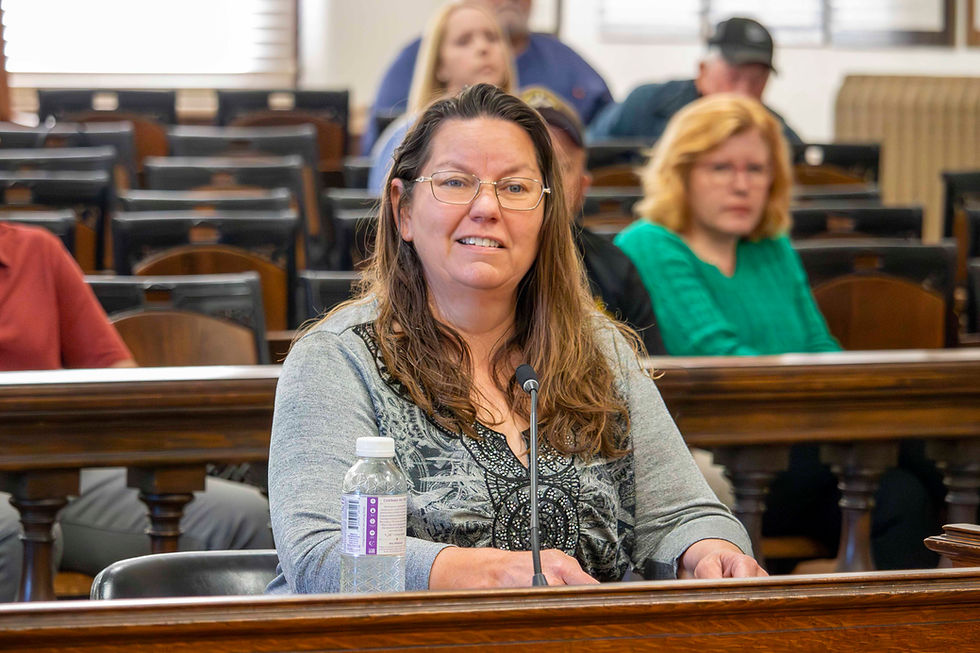
After no response, Brenton asked the question again. This time, it was met by Langdon informing her that the public comment portion of the meeting is “just an opportunity for public comment. It’s not a question-answer session.”
“So, by silence, we're going to recognize that the auditor of this county is ignoring my question, refusing to answer it,” said Brenton. “I've sent multiple emails.”
“Again, we have to be careful about throwing accusations,” Langdon said. “That's not what this is saying. This is saying this is a public comment opportunity, but it's not–”
“I'm asking a question of a public official,” interrupted Brenton. “And, certainly in a democracy, we would want people to ask questions of the public officials.”
“She has office hours, and you can go ask that question then,” replied Langdon.
“Where is it written that it is somehow inappropriate or outside the rules to ask the questions of the people who are sitting in front of me?” asked Brenton.
Langdon then informed Brenton that she had 19 seconds of time remaining. Brenton then proceeded to count down aloud from 19. She then stated she feels it is a “shame” that the Board of Commissioners decided to “put in public comment restrictions.”
“Thank you for being the Mouth of Sauron today,” Brenton said. “If you don't know that reference, you're not as educated as you claim.”
After stating that he was not able to hear what she said, Brenton repeated herself, this time nearly yelling, “you are the mouth of Sauron today!”
“Oh, that doesn't sound good. I hate that,” Langdon replied.

After 20 minutes of public comments, the meeting pivoted to the next item on the agenda, which was approval of the April 7 meeting minutes. Ewen and Marshall voted in favor, Cardwell opposed. However, they had a brief discussion before the motion passed.
“Mrs. Bowers just came up and it sounded like there could be some issues with the minutes…” said Langdon. “Is there a specific objection to the minutes? I just want to make sure that there’s never an opening for an open door complaint against this body.”
“They're never complete. And I bring it up, meeting after meeting, and I get tired of talking about it.,” said Cardwell.
“Is there something from the last meeting that's, in your opinion, not right?” asked Langdon.
“Inaccurate. Inaccurate and they’re prejudice,” Cardwell replied.
“I wasn't here at the last meeting. Is there something specific that you want to address?” Langdon asked.
“Overall, they are prejudice,” Cardwell said.
“What was wrong with the last meeting?” asked Langdon.
“They’re just not correct,” Cardwell replied.
“What is misleading about the last meeting minutes?” Langdon asked.
“Anybody who wants to read it can clearly tell what is wrong with them,” said Cardwell.
“Is there a specific–” began Langdon.
“The whole daggone page is just way off,” Cardwell said.
They then voted to approve the minutes. They then moved on to an issue regarding the city’s ownership of a property at a foreclosure sale being contingent on the removal of delinquent taxes accumulated by the previous owner. Attorney Mark Clark presented the case to the commissioners along with Mayor Justin Green.

“My name is Mark Clark. I'm an attorney that is working with the city of Salem regarding the foreclosure of a judicial lien on a piece of property here in the city of Salem. It's specifically at 103 West Homer Street. We're going to be going in about five minutes to a foreclosure sale on that lien. And one of the things that needs to occur so that that sale process can take place is the removal of some previous delinquent taxes that were on the property. We're talking a sum of about $10,000 to $11,000 of back due delinquent taxes on a piece of property that the city took action against based upon the inhabitable status of the home that was on that property. It was a dangerous building, and that building was removed. The city is now trying to foreclose upon its lien. And as I said, we need to have some delinquent taxes removed so the sale can take place. I had discussed with the treasurer, the auditor and the assessor a petition under Indiana Code, that they have signed and presented to the commissioners, that is the process by which a county may remove delinquent taxes, interest, fees, penalties, so that the sale can take place, and so the property can be sold to a new owner. In our particular case, it's going to actually be gifted to a new owner, and then that property will come back onto the assessment rolls of the county… What we would suggest is you could either act on the petition now, or the sale is going to take place at 10:00 am. If you want to make your action contingent upon the city being the successful bidder you could do it that way, and we could notify you of whether we are or are not the successful bidder.”

“I've got concerns,” Cardwell said. “After investigating myself and everything, and I actually talked to April yesterday, we cannot relieve the taxes on this until the municipality within our county owns the property.”
“That would be the second option,” said Clark. “I said if you wanted to wait until after the sale and make it contingent on the city being the successful bidder, you could do that.”
“I understand that,” Cardwell replied. “I'm not going to walk down that line on anything on ethics or whatever. I'm going to be on the side of moral compass and judgment. So I think if you guys are successful, then you probably ought to come back at that point where we can relieve it. That makes it totally lawful at that point. I had also talked to the lawyer with the SRI, and he explained it to me in such a manner also.”
“You want to wait until 10:15? That’s fine with me,” Clark replied.
When Mark Clark and Mayor Green returned at the end of the meeting, they reported that they were the successful bidders. The commissioners then voted to remove the delinquent taxes on the property.
Although not an agenda item, Commissioner Cardwell invited Paul Eckart forward to provide an update on the Highway Garage Project. One item he mentioned was building “the six bays at a different location on the job site.”
“Was there a change order approved on changing the location of them six bays?” Cardwell asked. “I'm just curious.”
“There wasn't a change order approved. It's all done within the 4.8 [million dollars],” Eckart said.
“So you're more or less covering that?” Cardwell asked.
“Yes, we worked out how we’re going to do that,” he replied.
“Worked out with who?” Cardwell asked.
“Phil [Marshall], the county representative,” Eckart responded.
“But anything that's done by the commissioners in the county needs to be ratified in a public meeting. I can't emphasize procedures enough,” Cardwell said.
“Phil is the department–” began Ewen.
“It’s still got to be ratified in an open meeting, Todd,” Cardwell said. “We got a lawyer sitting right here. Your opinion on that, sir?”
“I think it falls within the budget,” Langdon replied. “It does. At least that's what I'm hearing. And again, this wasn't on the agenda. I didn't prepare for it, but I think it falls within the budget.”
“But it was a change of location and this and that and all. I’m just saying I don't think we follow the proper procedures, and I'm pushing for that.
“Would there be a difference if it was a receptacle? Like if it was a plug on a wall?” asked Langdon. “If they wanted to move a plug from one wall to another wall, would you want a change order?”
“It could be,” Cardwell said. “We can all be buttholes or whatnot and get technical. I'm just asking.”
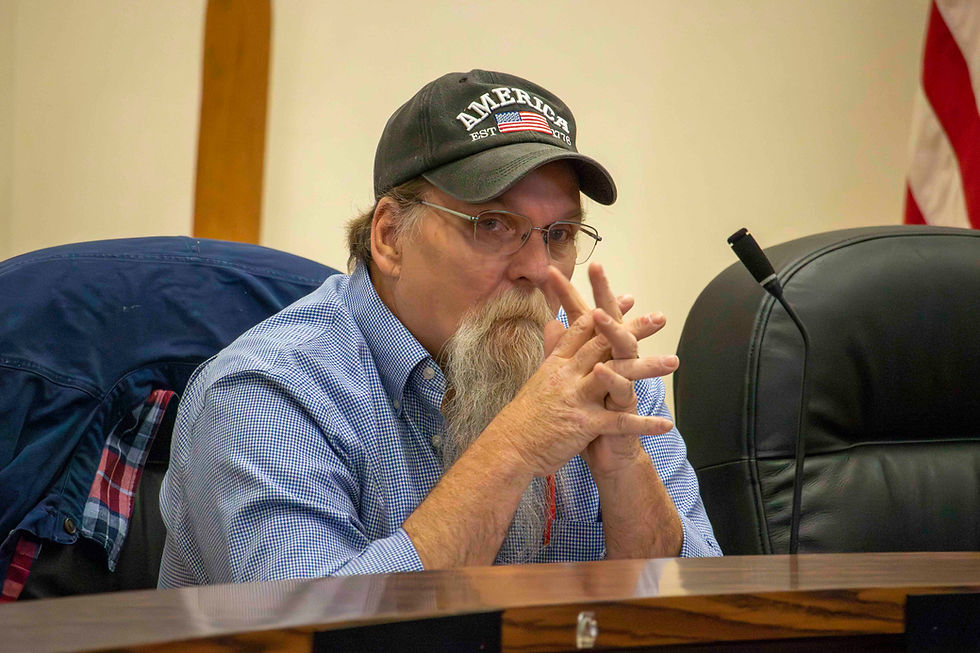
“I'm just trying to understand, so when I talk to April [Geltmaker], I can explain to her your position on it,” Langdon said. “So every change in every facility that's ever made needs to come before the Board of Commissioners?”
“I think they need to be ratified, in a sense to where everybody knows what’s going on,” Cardwell said. “That's been an issue here, and I know the council's had an issue with it, too, over this particular project. We work as a board. I'm not saying I'm against anything. I'm actually for it. But when I get a thousand questions over it, I need to be able to answer them. But that don't only make me look like a fool, it makes you look like a fool, too, when I can't answer and they say, well, you're on the board. Well, when people's going behind everybody's back, you can't answer the questions. Right, Phil?”
“Is there anything specific you want to know about?” asked Commissioner Phillip Marshall. “Yes, we’ve had problems. And yes, I know there are a bunch of people wanting to create a monster here. But we’ve got a building to build in a timeframe that should’ve been done six months ago, and that’s what we’re trying to get done. And the state doesn't just give him an answer in five minutes. We have to wait on them. And then everything else can be complex. It's not an easy procedure… Everything has to be done by the state and the statute. Now, at the same token, Tony, at this point you don't have them answers in a book. And that man's [Eckart] bent over backwards to get this thing going.”
“I'm not dogging at him. I'm just saying that the procedures is not properly followed,” Cardwell said.
“Can you be more specific?” asked Commissioner Ewen.
“In general, Todd! In general,” Cardwell replied.
“You never give an example. You're never specific. You just make these things up,” Ewen said.
“I'll give the specific thing, and this was already brought up before in the public meeting, $181,000 and some change and in stone should have been run through a change order process. At that point in time that you guys are trying to blame somebody else for not paying for it when we should have put that in on a change order because it's above and beyond an expense,” said Cardwell.
“It is in the process of–” began Commissioner Ewen.
“But we done done it. It should have been done prior to that,” Commissioner Cardwell said. “So, fess up to the mistake and let's get the stuff and start proceeding in the proper procedural ways.”
“You’re right,” said Ewen. “That change order should’ve been done a couple months ago, and it wasn’t. So, does that solve anything? It's being done right now.”
“Thank you for admitting that,” said Cardwell.
“ Now, if you have any other questions, I suggest you go to the project lead and call them up and ask him,” Ewen said.
“Any action he takes on behalf of the commissioners needs to be ratified in an open public meeting,” Cardwell said.
“Absolutely not because he’s [Marshall] the project lead!” said Ewen.
“That’s your opinion,” said Cardwell.
“You want it? You want the job?” asked Marshall.
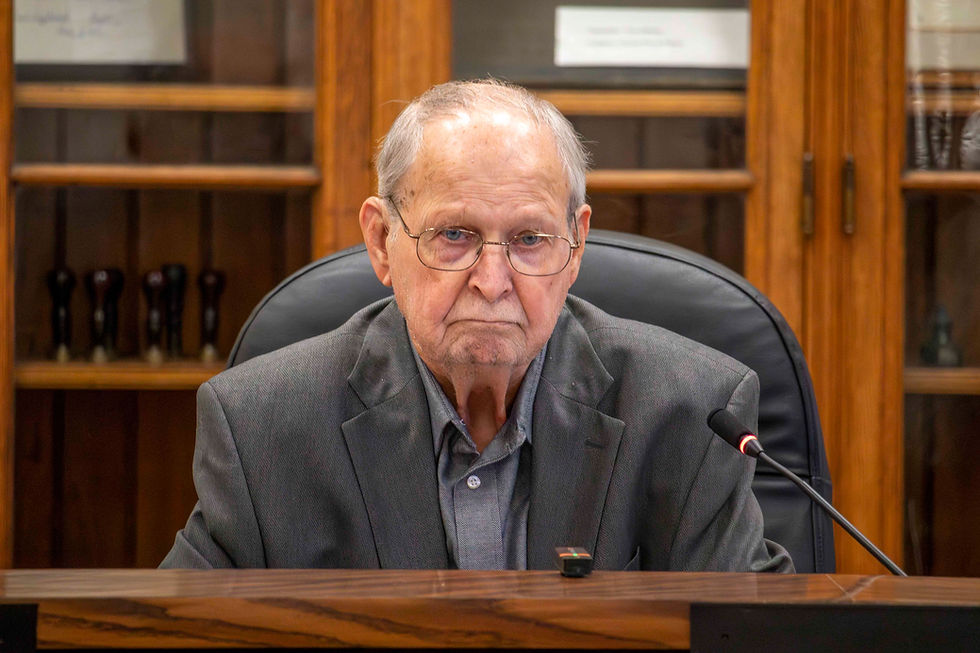
“Give it to me! I’ll do it!” Cardwell said.
Marshall then handed a large stack of papers to Cardwell. Although this exchange occurred, a vote never took place to change project leads. Commissioner Phillip Marshall remains the project lead.
“Didn't we lose 19.5 acres because we were over budget?” asked Brenton from the gallery. “And how can we be over budget on a 360ft building that's only 285ft long?”
“Nobody’s over budget," said Ewen.
“You told us you bartered 19.5 acres because we were $400,000 and some change over budget. So which is it? Are we over budget or not?” asked Brenton.
“We’re done,” said Ewen.
Cardwell then asked Eckart for an update on asphalt.
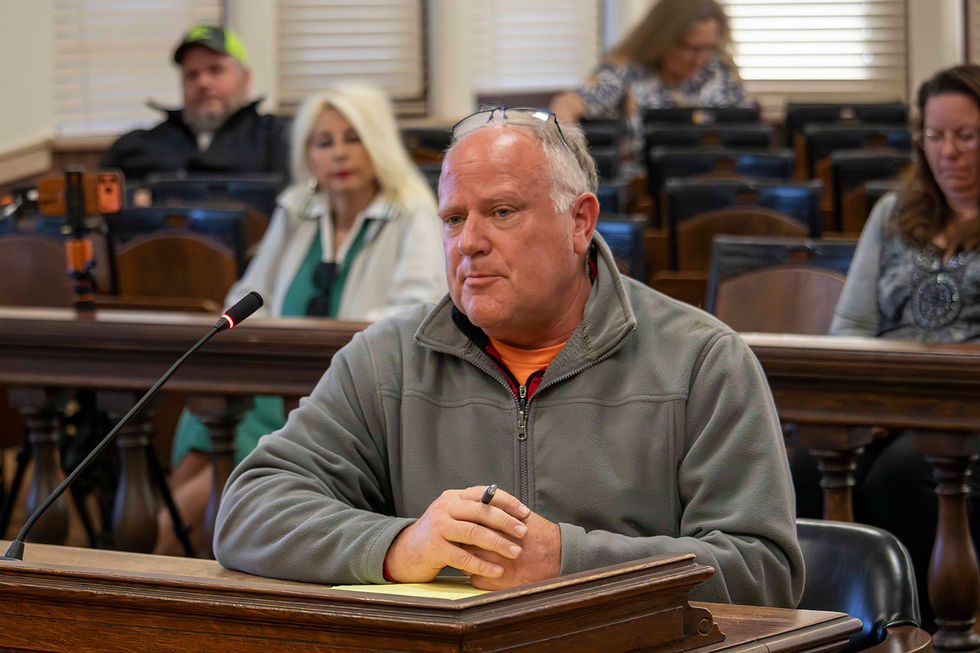
“The drawings are at the state to get the vertical construction going,” said Eckart. “They haven't been approved yet. We did get the foundation release though, so we have the foundation in. As soon as we get the vertical construction – the contractors already got the PO for building it. So, we're just waiting on that to give it the green light. On the asphalt and the fencing, I know there's a discussion about additional asphalt we wanted to develop at the same time to not work around fencing. It would be a bad job. We're just kind of in limbo on that for a moment.”
Following this, the Board of Commissioners made a motion for a recess while they waited for Mark Clark and Mayor Justin Green to return from the foreclosure sale. As stated previously in the article, the city acquired the property, and the commissioners removed the unpaid taxes. The meeting then adjourned.



Comments