


Council presses for answers on BOT agreement, highway superintendent presents project timeline

Updated: Mar 4
The Washington County Council convened at 9:00 Monday morning, March 2, during which the build-operate-transfer (BOT) agreement that has been a controversial topic lately was discussed in more depth.

“The next thing is the land swap for the highway project,” Council President Brad Gilbert began. “I know Alyssa (Cochran, Council attorney) has been communicating with us as a council through this process since we asked the questions that Karen (Wischmeier, Council member) had brought up, a specific statute, and we had other questions about it, so I'm going to turn it back over again to Alyssa for clarification so the public can see what we're doing now.”

“So in April of last year the commissioners came to our meeting and they brought the attorney they had hired to assist with the land swap, who is Dave Umpleby,” Cochran said. “Mr. Umpleby had, at that meeting, communicated with me about the specific Indiana Code provisions that the commissioners were relying on to engage in the transfer and their interpretation of whether that transfer required council approval. So that particular statute does say that the county fiscal body – which is this body – needs to approve a sale over $50,000. However, the commissioners can approve something that is not a sale, just a transfer, which is how they constructed that agreement. And because it was not a sale, it was a transfer, that is why council approval was not required. And that's what Mr. Umpleby came and presented to this council.
“That was my reading and understanding of the statutes, and that was in April. I don't know the timeline of what happened after that. I didn't have any more discussions with Mr. Umpleby after he was here at the meeting in April. So, I provided you all with the specific statutory sections that they relied upon or that they explained to us at that April meeting. The definitions that are listed in that statute that explains which county body can approve different types of transactions regarding the land, so I didn't receive any followup questions to my email, but I'm happy to answer follow up questions if there are any related to that.”
After some discussion, Council member Andrew Davisson spoke up.
“The one question I would have,” Davisson said, “I don't disagree that the commissioners could transfer that property, but for a change order... so the council approves the funding for the project, and there was a change order for six aggregate bins, right? For the transfer of the property? But in one of the last commissioner meetings, their attorney stated there had been no approved change orders. So that's where my question comes in.”

“Right,” Cochran replied. “And I do not know the procedures the commissioners have followed as far as what they have approved, what they haven't approved... I asked to see a copy of the transfer agreement, but I haven't been provided with a copy of that transfer agreement.”
“You asked for it?” Davisson said.
“I did,” Cochran responded.
“I mean, if they're basing it off of the code that you just stated, then how did they follow IC-36-1-11-2 that defines what a disposal is, of property?” Wischmeier asked.
“What do you mean, how did they follow it?” Cochran said.
“Well, that defines disposal as a sale, exchange, transfer lease of real or personal property by a political subdivision, so it states there that you've got to first define what your disposal is before you move onto your next code,” Wischmeier said. “So I guess I'm concerned, like how did they define that this property should be disposed in the form of a transfer, like Mr. Davisson was talking about?”
“My understanding is that they have an agreement, like an actual transfer agreement, or something along those lines,” Cochran said. “That's what I was saying, I requested to see how exactly they structured it in the agreement they put together, just to help me answer your questions, but I haven't seen an actual copy. But my understanding, based upon what their attorney came and said at our meeting in April, was that it was structured as a transfer. And so that falls within the definition of disposal under that statute.”
“So in a BOT, they're structured to where there's no change orders, it's actually a change of scope, correct?” Gilbert asked.
“Typically,” Cochran replied. “Again, I haven't seen this one, but typically the general rule in a BOT is that there aren't change orders, is my understanding.”
“They're considered change of scope?” Gilbert asked.
Cochran confirmed this.
“Well, in a true BOT, I don't think there's any change of scopes or change orders, actually,” Davisson said.
“I was just mentioning that so if anyone was like ‘it's change of scope versus change order...’” Gilbert clarified.
“Well with the BOT and the 4.8, we shouldn't even be giving this land away,” Councilman Preston Shell said. “and then there's other things that are involved too on this, where the ARP money was given to the contractors instead of through Temple & Temple, it was paid to the contractors... that wasn't supposed to be done. So, I don't know. It's really a mess. I think the Council has not been updated... let us know what's going on... there's a lot of money spent that's unnecessary.”
“In 2024, this council had representation, multiple people, that were going,” Gilbert said. “That faded before 2025. So you're right, we have not had all the communication we were supposed to have. We've not been involved in the process to the extent that we should. I will say, going forward, (Commissioner) Phil Marshall has agreed to have three members of the council in every meeting going forward. Andrew has volunteered to be one of those. Bubba (Council member Mark Abbott) was the past president, so he is going to stay a part of that, and I was gonna do that as the current president. That would give us three... but if someone else wants to step up and do that, they're more than welcome to.
“So we're going to take the commissioners at their word,” Gilbert continued, “and I know (Commissioner) Tony Cardwell is onboard with this as well, that we are included going forward and we are represented. So, that will help. And then if that doesn't continue to be the case, then this council has other recourse to go. Are you guys okay with that, or do you want to do something different?”
“I'm okay with it... if it works,” Shell said. “If meetings are set, you know. If it's not behind closed doors, you know. Can't have any closed doors. Behind closed doors... those are always going on.”

“Karen, what are your thoughts on that?” Gilbert asked.
“We need to do it publicly,” Wischmeier said. “I mean, I think the meetings of secrets have caused us a lot of problems, it sounds like. I mean, if we're paying subcontractors out of the ARP money and then we're paying them too, somebody's double dipping, and how much, you know, if what he's saying here is... this is worse than I ever thought it would be.”
“Do you want to address the concerns about the ARP money that you're working on for us?” Gilbert asked. After a moment of silence, he continued. “So, council has raised concerns, reports about the ARP funds from the auditor's office, who are cooperating with us at this point. I've asked Alyssa, when we start getting those, to look at everything and make sure all of that money was appropriated in the correct way, because of the concerns that you mentioned – double dipping, possibly – and all that. So she's agreed to be a part of that process too, and come back to the council and answer any of our questions about that.”
“Yes,” Cochran said. “And so, to go off of what our council president said – any time you have questions, specifically that are going to be highly governed by statute, which is most of what you all do – the more specific questions you all can give me, the easier it is for me to kind of run down where that falls in the statutes, where the appropriations are, all those kinds of things. And so, if you have those, please send them to me. But I will do my best to always provide a general overview of any questions that arise. But I haven't seen those specific numbers and I don't know exactly where you all think there might be some issues. So if you want to let me know that, that would be helpful.”
“Can you guys provide specifics to her?” Gilbert asked.
“I mean, if a BOT states we're not supposed to be paying any money until the project is done, that's how it was outlined to us as a council when we were still learning what a BOT was and how it worked and all that stuff. We were told that we give them a project, we give them the scope of that project, we finalize said project, and then we as a council secure the funding for them,” Wischmeier said. “The commissioners enter into an ordinance that says ‘hey, we can do a BOT in this county’. They enter into that BOT, there's no change orders whatsoever. There's no payment made whatsoever until the end of the project. And then at the end of the project, the engineer or the designer or whatever they call them gets paid at the end of that said project, and then we transfer after 30 days. That has not happened at all. And it sounds like now it's been paid throughout the process.”

“Well, according to our attorney for all this, we were fine to pay these things periodically as they were done,” Auditor Kyra Stephenson said. “We did not pay in advance, we paid as they were done. So, the one that you're talking about, the Miller Heating and Cooling, that was paid out of our – that was paid – Temple's did give us a credit for that, and that was fine. Our attorney, we did ask him about that. It was fine that we'd done that. At the time, we had the ARP money, we were trying to get rid of it because if you didn't spend it you had to give it back. So that's where that came into account on that one. And like I said, Temple's did give us a credit on that.”
“There were six bays that wasn't built, and I've asked three or four times, Tony (Cardwell, Commissioner) asked two or three times, on the breakdown of that $108,000 that Paul Eckert said, and we've not seen it,” Shell said. “You know, so it's very upsetting, you know. Because they need to keep us in contact if we ask questions.”
“The six bays, that's what we're swapping the property for, right?” Wischmeier asked.
“No, the aggregate bins,” Shell replied.
“Oh, the aggregate bins,” Wischmeier said.
“So these are the questions that you're requesting the council send to you?” Gilbert asked, turning to Cochran.
The council members agreed to send Cochran more of their specific questions.
“I think where a lot of confusion about the BOT stuff comes in is, the contract doesn't read like a BOT,” Councilman Andrew Davisson said. “It says ‘BOT’ at the top of it, but it's not.”
“The attorneys we used have done a BOT before, so I feel certain they know what they're —” Stephenson began.
“Well, BOTs are pretty cut and dry with the State, you know, when you talk to them,” Davisson said. “In the contracts, there isn't any wiggle room. You can call it a BOT but it's actually a design-operate-build, and it actually says it in the contract.”
“So we passed an ordinance for a BOT, and then didn't even follow our own ordinance,” Wischmeier said.
Gilbert asked if there were any other questions or comments. There were none.
“So, everyone on the council that has any specific questions, we'll get that to Alyssa,” Gilbert said, “and then going forward we're gonna give them the opportunity to follow through with giving us seats at the table, so I think that's at least one step in the right direction. If that doesn't work, we have other avenues to pursue.”

At that point, the next item on the agenda was reports by department heads. Highway Superintendent Rick Voyles came to the stand with a packet of papers.

“This BOT...” he began, “the fuel tank issue at the highway department started in 2021. In 2023 is when the BOT talk started. And for a good while, nobody said much about it, but here in the last six months it's been a hot topic. And people talk about the highway department – well surprise, surprise – they call the highway department to ask questions about it. I don't have the answers, and when I tell them I don't have the answers they seem to think I'm being dishonest because they think I should. I got to thinking, and a lot of the council wasn't here in 2021 or 2023, none of you were on the scoping committee, and just like the people I talk to on the phone... they don't really have a timeline. They're starting six months ago, just right in the middle.
“So I went through my files, and put together a few things here to kind of build a timeline that I would like to hand out to you, just to get you up to speed. Probably nothing you don't already know, but I just thought we could go over it.”
PAGE ONE

“Alright, page one there, this is where it all started, the seed that started the growth,” Voyles said. “We received an IDEM notice about some issues we had, mostly about insurance and things, but in that email, dated September 21, 2021, they pointed out to us that our fuel tanks were 30 years old and needed to be replaced. So that's where this all started, to kind of build us a timeline.”
PAGE TWO

“Moving forward, December of 2021, we were sending out some feelers on getting prices on fuel tanks.”
PAGE THREE

“June 16, 2022, we ordered the fuel tanks, and you'll see there – this will be important here in a second – the site had not been picked yet. So we ordered the tanks, and we didn't really know where they were going, but we knew we had to replace our tanks.”
PAGE FOUR

“June 21, 2022, the commissioners approved the ARP funds for our fuel tanks. I would like to point out that the $440,000 – that included the funds to remove the old tanks, because as you'll see on the next page...”
PAGES FIVE – SIX


“...Our facility, #13266, is registered with IDEM just like a gas station. We do monthly inspections, we can't just walk away from those tanks. So don't think, if we go to this new place, that we just walk away from that because we're registered and have to do monthly reports. So we need to remember those funds are to remove those tanks as well. Our name is on those.”
PAGE SEVEN

“Alright, February 23, 2023, The Salem Leader publishes that we're going to have a BOT project. You can see at the bottom it's highlighted where we've been discussing it at previous commissioner meetings.”
PAGE EIGHT

“The scoping committee, it changed over time. There were three different versions, but the original was Phillip Marshall, Rick Roberts, Joe Walker, Kyra Stephenson, Rick Voyles, Brad Isaacs, and Paul Eckert.”
PAGE NINE

“Our first scoping meeting, Keeley Stingel, the council president, attended and handed us out some guidance documents. This first one shows the steps you take in what order.”
PAGE TEN

“The next page – this was the legal breakdown or description of the BOT. This was handed around, it wasn't passed out, but I took a picture of it whenever it was handed around, but it kind of gives you an outline. I'll say it was a brief version of the law.”
PAGES ELEVEN – FOURTEEN


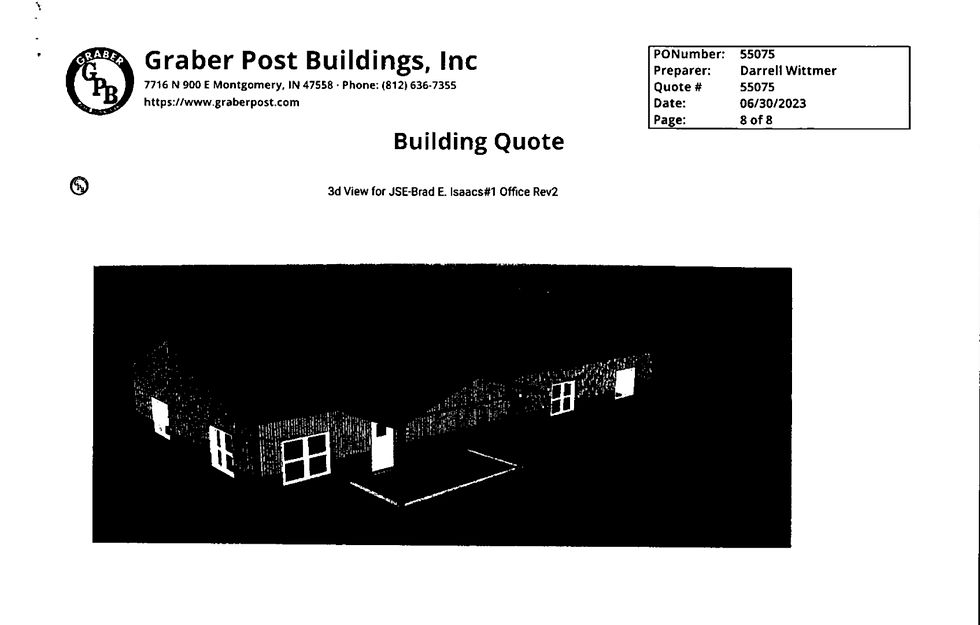

“These are just random pages from the Graber quote. You'll see 4/17/23, 5/12/23, 6/30/23, and then finally, the site plan, at the bottom right there, you'll see 7/24/23, so we're almost up to August. Now, turning the page...”
PAGE FIFTEEN

“December 31, 2023, I stepped down as highway superintendent. Jason Clodfelter took my position January 2024, he had no involvement with the BOT. Jason stepped down in August of 2024, and I resumed the highway superintendent position September 2024 with no involvement with the BOT. January through December 2025, no involvement with the BOT. January 26, I was asked to produce a BOT punch list.
“I would like to make it clear, a little disclaimer for myself, I do not have a copy of the final plans or the BOT agreement. So I was going from the records I had previously. Now the next page...”
PAGES SIXTEEN – SEVENTEEN


“There's two pages of items I've pointed out, that were missing, or questions I had about it.”
PAGE EIGHTEEN
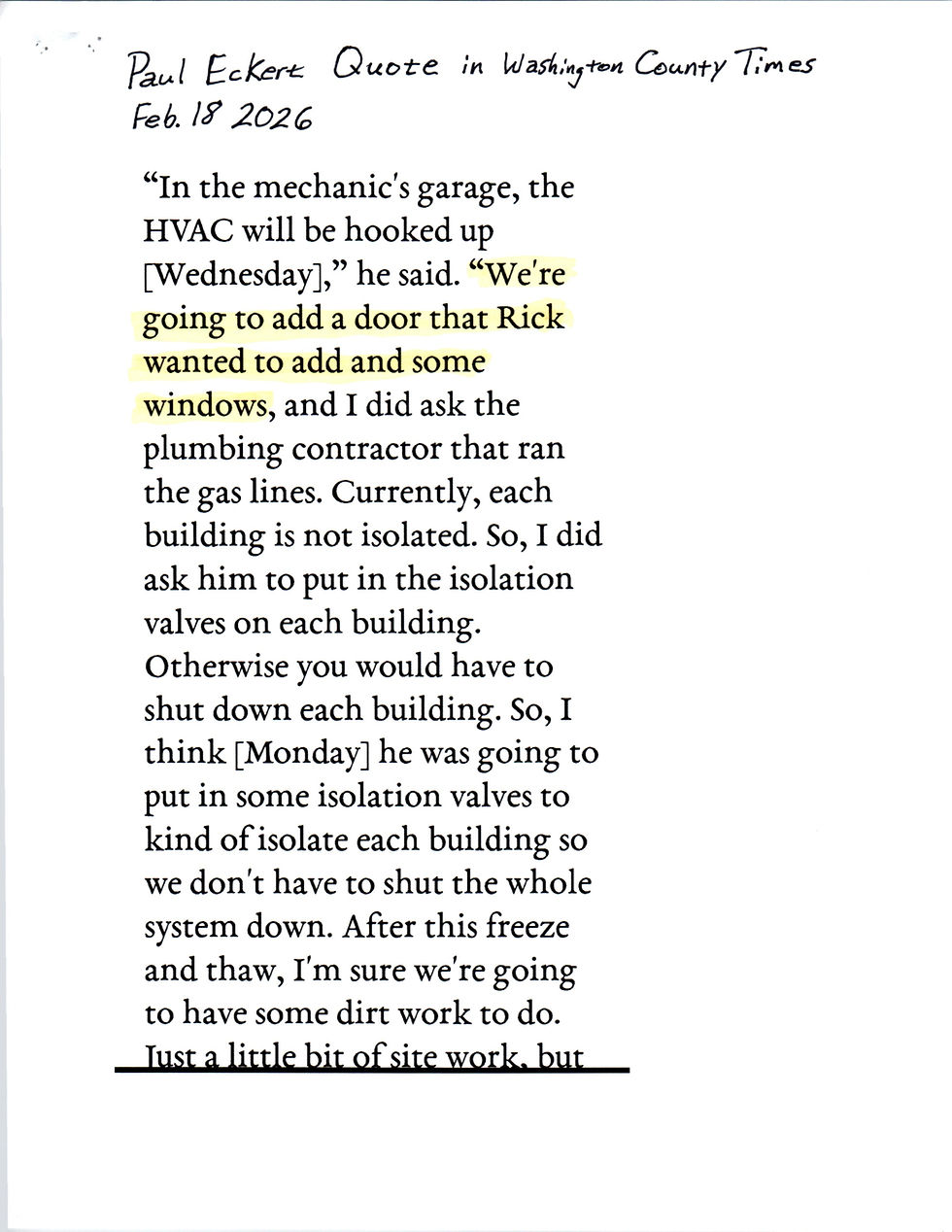
“The next thing – at the last commissioner's meeting, February 17, Paul Eckert gave an update, and he said something that was quoted in The Washington County Times. He said, ‘we were going to add a door that Rick wanted to add, and some windows’. Well, we all know that ‘change orders’ right now is a very touchy subject, so I take issue with that. And you'll see on the next page...”
PAGES NINETEEN – TWENTY

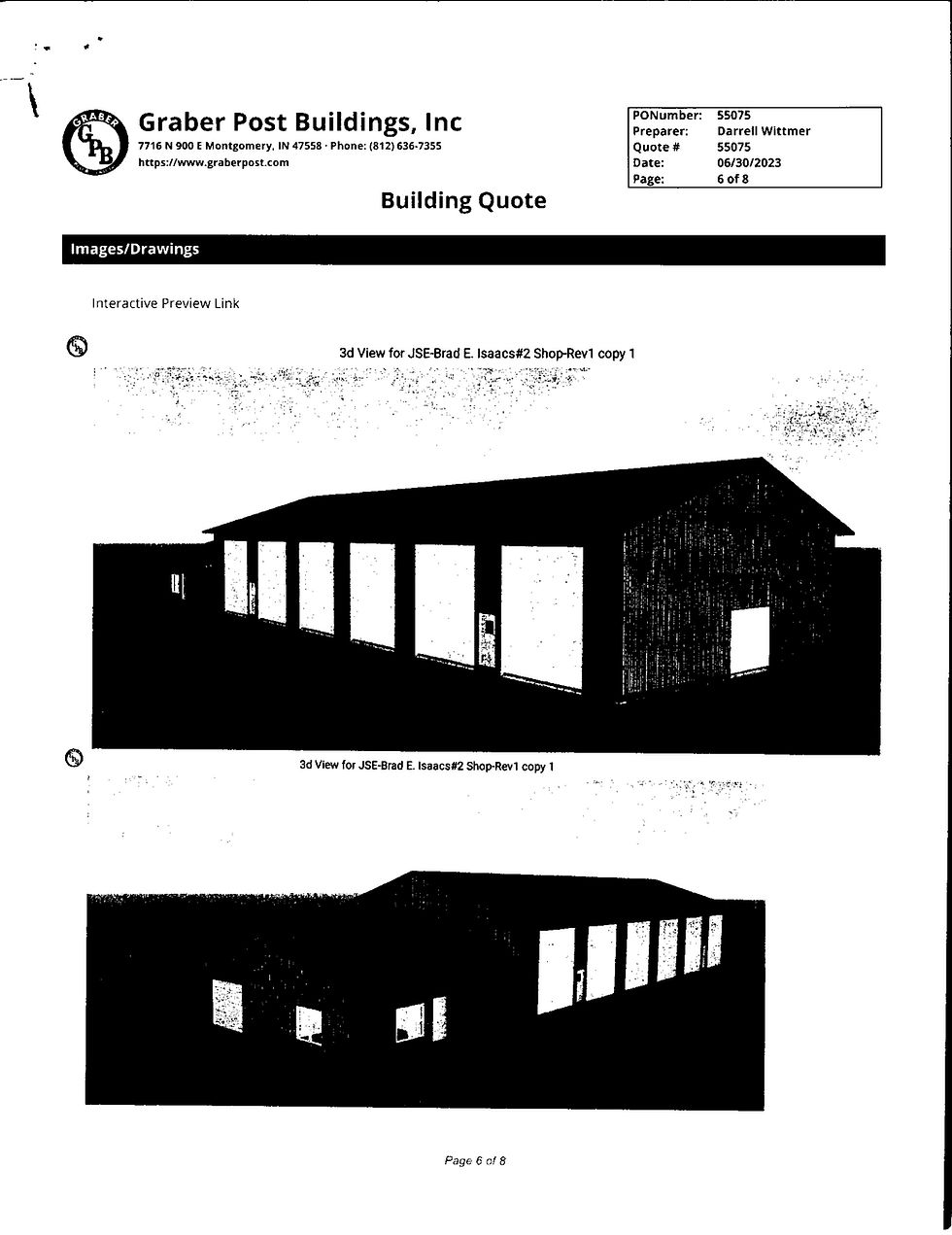
“The drawings from Graber dated 6/30/2023, and the next page, those are both of the shop. In those drawings from 2023, you'll see all of the windows and doors that are discussed there. So I was not adding anything, I was pointing out what was missing. I'd just like to make that very clear, because it would be easy to be the guy responsible for ‘change orders’ when I'm just pointing out what's not there.”
“That's it, if you have any questions feel free to get ahold of me and we'll discuss it. That's all I've got for you.”
The council members thanked Voyles and praised his work on the timeline.

After some discussion in which the auditor's office was thanked for their handling of backpay for county employees after the January payroll issues, and the Eastern Lady Musketeers were publicly congratulated for their State championship win the previous week, the meeting was adjourned.



Comments