


Election 2026: Candidate for U.S. Representative (D9) Brad Meyer

As the 2026 general election approaches, The Washington County Times is publishing written interviews with candidates in contested races affecting Washington County.
The Times reached out to all candidates for whom we were able to obtain contact information and invited them to participate. If you are a candidate in a contested race and have not received an invitation, please contact us so we can make sure you have an opportunity to participate.
Candidates were provided with questions tailored to their campaign, personal history, and the office they are seeking. We encouraged candidates to answer the questions in their own words and to refrain from using ChatGPT or other artificial intelligence tools when preparing their responses.
All candidate responses have been published as submitted, without editing or alteration. The Washington County Times does not endorse political candidates, and any opinions or statements expressed within the following interview are the candidate's own.
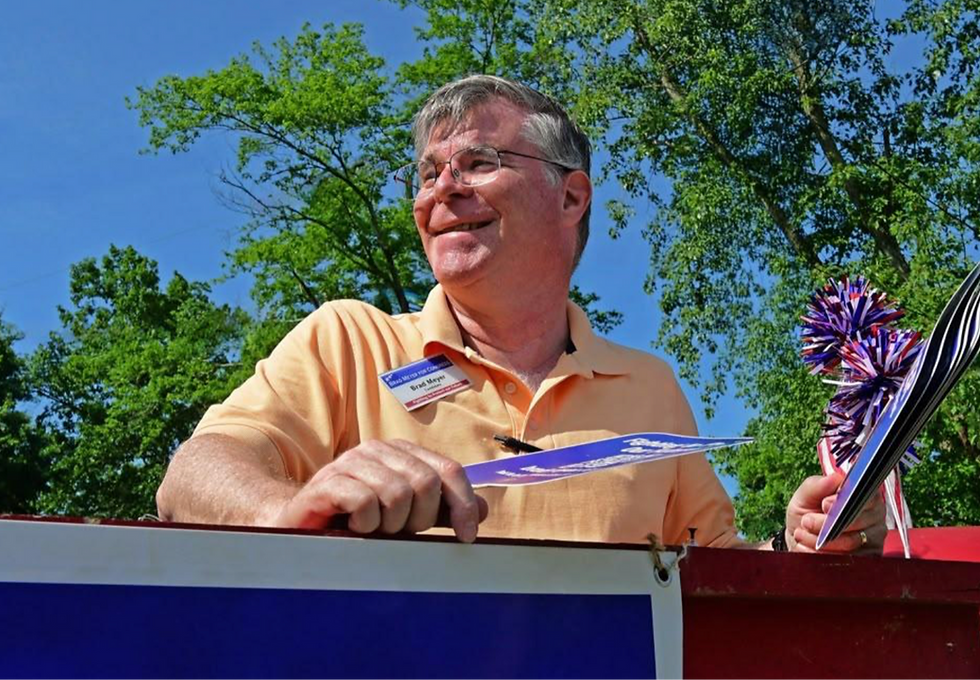
Why are you running for Congress, and why should voters in Indiana's 9th District choose you?
I am deeply concerned about the direction of this country and what the future looks like for all of us if we stay on the current path.

What do you believe are the biggest issues facing residents of Indiana's 9th Congressional District, and what specifically would you do about them if elected?
Medicare for All. Healthcare should be available and affordable for everyone.
Put families on a stronger economic footing. This includes addressing the issues of affordable housing, good wages, reducing the cost of an education, and making the tax system more fair.
Protecting Social Security. We must protect what retirees have earned and make sure it keeps up with the real cost of living to ensure that healthcare and income security are guaranteed rights for every retiree.

Washington County and much of southern Indiana continue to face workforce challenges. Southern Indiana Works recently found that Washington County has a labor force of more than 14,000 people, but more than 5,500 residents leave the county for work. What role, if any, should a member of Congress play in helping rural communities attract better-paying jobs and create more opportunities closer to home?
The problem is bigger than just going out of the county for work. People are moving away. Between the last two censuses, Indiana grew over 4%, but Washington County lost population. The current policies are hurting the county, the district, and the country.
We need to make sure rural communities have the basics businesses need: good roads and bridges, reliable internet, dependable water and sewer systems, and affordable, reliable energy.
We also need to stop making it harder than it needs to be for a business to get started and grow. The current administration cut funding for the Small Business Administration while Congress just stood by. Congress needs to help by supporting the Small Business Administration, expanding broadband and other infrastructure, and making sure people have the training they need to fill good-paying jobs.
What changes, if any, would you like to see in the federal government's approach to health care, and how would you propose paying for those changes?
The life expectancy in Washington County is 8 years less than Canada, which has 80% fewer people per square mile than Washington County. At the same time, we spend twice as much and are the only modern country where you can go broke just trying to stay alive.
This is why I'm a strong supporter of Medicare for All.
We're just spending too much of it on insurance companies, paperwork, and profits. I think we need to change that and put more of the money we're already spending into actual health care.
Medicare for All is a proven alternative and can be done. Medicare was signed into law in 1965 and was up and running less than a year later. If we could do that in 1965, with the technology and resources we had then, I think we can figure out how to do Medicare for All today.
I don't expect it to happen overnight. But we're already spending the money. We need to move that money from a profit-driven system into a nonprofit system that puts patients first. That's how I think we get health care costs under control and make sure people can get the care they need.


You have spent much of your career outside of elected office. What have you learned in your professional life that you believe would help you represent the 9th District in Congress?
My career has been as an engineer. I am a problem solver. Solving complex problems isn't following the directions of others. I've learned that when you're trying to solve a complex problem, you first have to understand what you're dealing with. That means gathering the facts, listening to the people involved, and looking at the information you have. Then you need to figure out the root cause of the problem, look at different ways to address it, and understand the costs and benefits of each. From there, you work with people to come up with a solution, implement it, and evaluate its effectiveness.
This is the approach needed to address the problems facing the people in the 9th District.

Your campaign has proposed increasing the federal minimum wage to $20, increasing the standard deduction to $20,000, and raising taxes on high-income households and large corporations. What would you hope those changes accomplish, and how would you respond to concerns about their potential effects on the economy, particularly on small businesses that may have difficulty absorbing higher labor costs?
A full-time job should provide the ability to afford a home, support a family, and build a future. This puts money back into the pockets of working families immediately. That will stimulate the local economy. Your earlier question talked about needing more local jobs; this is part of the solution.
Universal healthcare will also help. Businesses that provide healthcare will have lower costs.
There are always claims that anything that puts more money in our pockets will kill jobs and drive up prices. The fact is that inflationary concerns are ... inflated. Because wages are only a portion of business costs, prices do not increase nearly as much as wages. There is also evidence that higher wages help increase employee retention, decrease absenteeism, and increase productivity.

You have been holding town halls and meeting with residents throughout the district during your campaign. What have you heard from voters that has most changed or challenged your own thinking, and how would you continue that kind of constituent engagement if elected?
I've held over 30 live and 6 virtual town halls this year. Throughout all of these town halls, I keep hearing repeated concerns: the cost of healthcare; the difficulty in making ends meet; living paycheck to paycheck; the concern about losing Social Security benefits; the cost of housing; fuel costs; and the concern about data centers.
One of the things I have included in this campaign because of my meetings with people across the district is disability advocacy. I don't have a direct personal connection to the disability community. I didn't need one. Listening to people talk about the barriers they face helped me understand where our policies are failing them and where we can do better.
Personal experience can make any of us passionate about an issue, especially when it affects someone we love. But public service requires something more. Policies are being made in Congress by people earning $174,000 a year that can have profound consequences for people who are hungry, disabled, or sick. We need leadership where compassion, concern, and advocacy extend beyond the boundaries of a representative's personal experience. We aren't seeing enough of that today.
Members of Congress often have to balance their own judgment with the preferences of their constituents. If you believed a particular policy was in the best interest of the district but polling or direct constituent feedback showed that a majority of your constituents disagreed, how would you approach that situation?
All leaders bring their initial perspective to a topic. We should not just turn over decisions to polls, but we need to keep an open mind long enough to review the facts and talk with stakeholders.
I am not a user of cannabis, and my initial bias was against legalization, but a strong majority of Hoosiers are in favor of legalization. After researching the issue and talking with Hoosiers, I came out in favor of full legalization.
This is a case where I agree with Libertarians that we need to limit the number of things we limit.
If elected, you would enter Congress without previous experience in elected office. What would be your first legislative priority, and what specific result would you want to achieve during your first year in office?
My first legislative priority will be working on economic policies that favor people over big businesses. Decades of big business over people have shown up in lower wages, less opportunity for young adults, and expensive healthcare. It doesn't have to be this hard.
At the end of your first term, what specific accomplishments or results would you want voters to be able to point to and say, "This is what my representative accomplished for Indiana's 9th District"?
Right now, only about half of 30-year-olds are doing better than their parents were at the same age. Washington County has struggled with low growth, as have many rural communities across America. Congress isn't doing its job. It's just managing our decline.
These problems have been a long time in the making, and I can't promise they will be fully fixed in 2 years. But at the end of my first term, I want people across the district to be able to see that things are moving in the right direction, and that they have a representative who is really working to help them get a fair shot at a decent life.
That's how I want voters to measure what I've accomplished.


Comments