


Commissioners pass data center moratorium, approve county health insurance


The Washington County Board of Commissioners met on Tuesday, August 4 to unanimously approve a one-year moratorium on data centers and adopted new employee health insurance plans designed to reduce a projected cost increase for both the county and its employees. Commissioner Marshall was still absent due to a “mild stroke.” Auditor Kyra Stephenson was also absent during this meeting. County Surveyor Emily Rodman joined the meeting in Stephenson’s stead.
The commissioners also recommended a $10,000 spay and neuter voucher program for the County Council to consider in the 2027 budget, and they approved a work-based learning agreement with West Washington School Corporation.

As per usual, the meeting began with public comments. Three individuals signed up to comment: Jennifer Bowers, Lucy Brenton and Angie Williams.
Bowers began by thanking the board for updating the county website’s list of boards and commissions. She noted that the Regional Development Authority, Washington County Plan Commission and EMA Advisory Board had been added since she raised the issue in June.
She then stated the Washington County Farmers and Merchants Fair, Inc. organization is registered as a nonprofit according to the Indiana Secretary of State, but that it does not appear in the IRS database of nonprofits. Bowers asked whether the county has a contract or memorandum of understanding with the fair board. Commissioner Todd Ewen confirmed that a county contract exists and is a public record available through the auditor’s office.
Bowers shifted to comments made the previous day by Fair Board President Tom Day about signing a contract regarding the dirt track. She asked whether the fair organization is authorized to enter such an agreement, given earlier statements that its responsibility is limited to putting on the fair. Commissioner Ewen replied that the existing contract has allowed the fair board to take similar actions for years and that the track lease falls within its rights.

Then she asked about two outstanding public records requests that she has made. On June 23, she requested the two appraisals of airport property that was transferred to Temple & Temple as part of the Highway Garage project BOT agreement. She received confirmation the same day but said she had received no records or further response despite a July 23 follow-up. In a second request sent June 24 to the county treasurer, Bowers asked for the resolution or other authorizing document for the $2 million financing on the BOT project, the executed promissory note from the loan security agreements with First Savings Bank related to the $2 million financing, and any Department of Local Government Finance (DLGF) correspondence. The treasurer directed her to the auditor, but Bowers said she still had not received the documents.
Commissioner Ewen indicated the materials would be provided when Auditor Kyra Stephenson returned. He also stated the loan agreement is “about 4.5% interest over seven years.”
Lastly, Bowers reported seeing an automated license plate reader camera at 11752 State Road 56, west of Highway 39 near the turnoff to Little York. She asked who installed it and whether county approval was required. Commissioners said they were unaware of the camera and believed it was likely placed by the State Police or another state agency, which does not need local authorization.

Lucy Brenton began with a very sharp critique of the County Council’s actions the previous day. She said she had closely watched the council meeting and was “beyond distressed and extremely disappointed.”
“They completely played us,” Brenton said. “When the camera and news crew were rolling, they played politics. They pretended to care about transparency. They pretended to have the taxpayers’ best interest at heart in a $1.7 million project that has been accused of fraud, fraught with frustration and anger in the community.”
She referenced notary records showing documents signed in 2024 by someone whose notary commission was not issued until 2025, and said hundreds of thousands of dollars in checks were issued that could not have been without that notary. Brenton specifically called out Council President Brad Gilbert, saying it appeared he was “happy to take that motion under the cover of saving taxpayers money.”
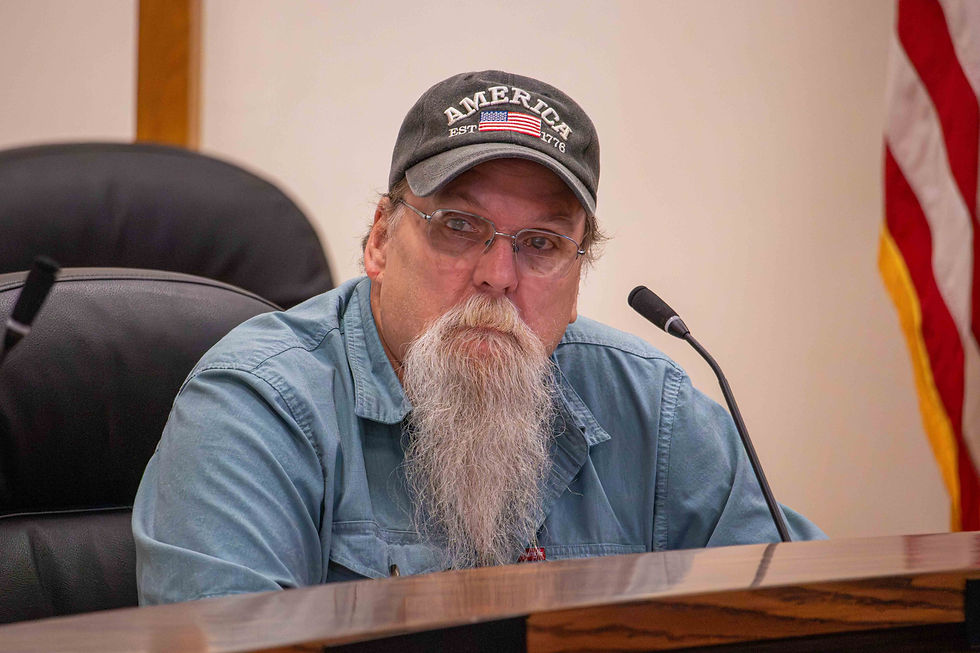
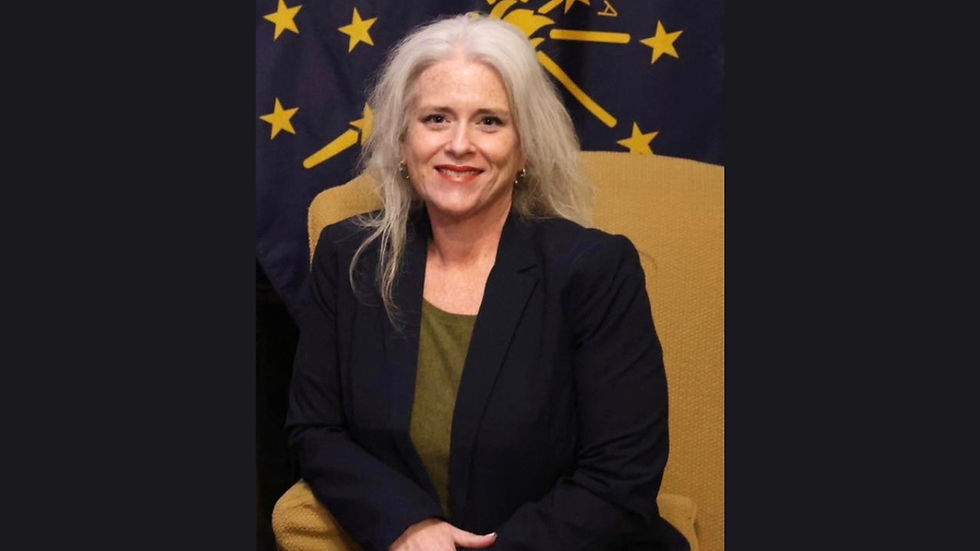
Lucy Brenton Brad Gilbert
“$37,500 is a rounding error on a $1.7 million project, and you and the council circled the wagons,” she said. “I believe, in my personal opinion, to protect each other. From what? Well, we don’t know because we are going to lack the transparency and the type of audit led by an attorney where we could actually discover the basis of the suspected fraud.”
Brenton said Gilbert had previously promised her he would support a full review. “I am extremely disappointed in you. You promised to be transparent… You came back and promised me, ‘Lucy, I’m going to vote for it. I believe in transparency.’ And then you did, until you didn’t, which was yesterday. I just can’t trust you anymore.”
When told the vote had been 5-2, she replied that only Preston Shell and Karen Wischmeier “stood up for the real taxpayers.” After a brief correction on Wischmeier’s name, she continued, “I am right to call out the entire county council with the exception of Preston and Karen because y’all circled the wagons. And I don’t know what you’re protecting, but I do know that the liability is that people that did this in bad action can pay out of their pocket.”

Brenton then “strongly urged” the commissioners to pass a one-year data center moratorium, citing concerns such as cattle stillbirths and large corporations with bad intentions.
“We are finding out that cattle ranches and other livestock operations in Texas have come forward to say that since data centers have started operating in their areas, there’s something about those data centers that’s causing stillbirths,” she said. “One rancher testified on video that he has not had a live birth since the data center started operating.”
She stated there are too many unknowns and said she would not tolerate “multi-billion dollar and trillion dollar companies gathering our tax dollars at the federal level and then funneling them into their own projects with private equity to bully us. That is what they have done in other counties…”
She continued, “If they can not do the bad things to us, if they cannot trespass against us, if they cannot cause us financial losses, if we can show that there is a way that they can do this without taking our water underground and collapsing our limestone caves and creating sinkholes from karst topography, then sure, build it. But if there is any chance that these multi-billion dollar companies have vampiric investors who want to suck the lifeblood out of Washington County, then the answer is no.”
She claimed approximately 8,000 acres in the county are already under option or lease and that companies have told investors they plan to co-locate solar and data center projects. “There’s nothing to stop them from doing that here in Washington County. They already have the options and the will to sue us. And so we got to get the moratorium in before they pull any permits.”
Brenton closed by noting there are four ALPR cameras in the county and directing residents to deflock.org.

Angie Williams also spoke in support of a moratorium. She thanked the commissioners for considering the issue, stating a pause would allow time for due diligence.
Williams listed several steps she wanted the county to take during a moratorium, including changing zoning on industrial land to make it less attractive to data centers, updating ordinances with strict requirements, ensuring adequate insurance in case of lawsuits. She also stated they should “be prepared to use the judicial system.”

She then outlined several potential environmental and community impacts:
Water table damage extending from a half-mile to two miles from a facility
Noise and light pollution
Air pollution linked to “increased rates of respiratory disease, heart conditions, and cancer”
Heavy strain on the electrical grid that could lead to rolling blackouts
Harm to livestock and wildlife
“Decimation” of property values
Developer funding for decommissioning plans so that companies cannot simply abandon sites.
“As you can see from the list I just cited, the benefits are really non-existent relative to the drawbacks,” Williams said. She argued the moratorium should ultimately lead to a permanent ban and noted that Marshall County, Indiana, has already adopted one. “We need to be good stewards of what’s been entrusted to our care.”
Williams’ comments were met with applause from the gallery as she returned to her seat.

Commissioner Todd Ewen then asked for a motion to approve the previous meeting’s minutes. Commissioner Tony Cardwell declined to make the motion. This halted the vote entirely as Commissioner Phillip Marshall was absent, making a 1-1 vote the only possible outcome.
“All right, then we won’t vote,” said Ewen. This was followed by the approval of claims and payroll.
The meeting then pivoted to the moratorium regarding data centers.
Attorney April Geltmaker read the proposed resolution. It defines a commercial or large-scale data center as a building or structure exceeding 2,000 square feet whose primary purpose is to house equipment or software used for processing, storage, retrieval, or communication of data.

The moratorium reads as follows:
“Whereas Washington County, Indiana, the county has been the subject of an increasing amount of interest in the development of commercial or large-scale data centers, which shall be defined as a building or structure in excess of 2,000 square feet whose primary purpose and design is to house data center equipment or software which is used for processing, storage, retrieval, or other communication of data;
“And whereas the Board of Commissioners of Washington County has previously adopted a zoning ordinance for the unincorporated areas of Washington County for its proper and effective development, and the zoning ordinances of Washington County do not currently provide any regulation to data center projects within Washington County. Data centers present land use impacts that differ substantially from traditional commercial or industrial development;
“Whereas the Washington County Board of Commissioners believe that based on the rapidly growing demand for data centers, there should be further evaluation and study of the environmental, economic, and utility affordability aspects and impacts of data centers before any data center projects are approved;
“And the Washington County Board of Commissioners believe it to be in the best interest of the county and its residents to first evaluate, study, and consider public opinion regarding the development or construction of data centers and the nature of data center development conflicts with the goals outlined in the current Washington County comprehensive plan;
“Now therefore, the Washington County Board of Commissioners resolve to invoke a temporary moratorium on all data center development in the county. This moratorium shall apply to, but is not limited to, any application for rezoning, special exceptions, conditional uses, variances, improvement location permits, site development plans, building permits, and any other local approval necessary for the establishment or expansion of a data center.
“This resolution shall be limited in duration to not more than 12 months and shall remain in effect until expiration or adoption of a zoning ordinance amendment designed to address data center development in the county. The duration of the moratorium shall be the absolute minimum necessary to sufficiently evaluate, study, consider public opinion, and adopt provisions to address data center development.
“The Washington County Board of Commissioners hereby direct the Washington County Plan Commission to proceed with the process of evaluation, study, and consideration of public opinion for the purpose of adopting an amendment to the Washington County zoning ordinance to address data center development.”
Commissioner Ewen spoke at length in favor of the resolution. He said he had researched the issue and that the first word that comes to mind is “ugly.” He stated that even the smallest data centers use a minimum of 100,000 gallons of water per day, and he compared that to local poultry and hog operations that use only a couple hundred thousand gallons per month. Once used, the water is “basically contaminated,” he added.
“My personal belief is I don’t think there is one square inch of property in Washington County that anybody should ever consider putting a data center on,” Ewen said. He seconded the motion made by Commissioner Cardwell and stated that while a one-year moratorium is the necessary first step, the long-term goal should be a complete ban.
The two voted unanimously to approve the moratorium. Applause followed from those in the gallery.
Zack Richards from Knapp Miller Brown Insurance Services returned with updated figures after more provider negotiations. SIHO reported that underwriting would not allow rates low enough to be competitive. Anthem reduced its proposed increase from 43% to 38%. However, this adjustment left large cost increases for both the county and employees under the existing plan.

Under a straight renewal of the current plans, a worker on the traditional $1,000 copay plan would have seen an increase of $31.15 per paycheck for employee-only coverage, or $132.76 with children. On the higher-deductible HSA-eligible plan, the increases would have been $13.99 and $106.32 per paycheck, respectively.
By switching to two new Anthem Health Sync plan offerings, the overall increase drops to approximately 7%. Under the new offerings, the employee-only increase on the traditional style plan falls to $9.34 per paycheck ($39.94 with children). On the high-deductible HSA plan the increases amount to $1.85 and $14.44 per paycheck.
For our county, the expiring plans cost $1,141,217.65. The adjusted Anthem renewal would have raised that to $1,578,011.89. The two new plan options are projected to cost the county $1,223,003.95, which amounts to an increase of roughly $81,786.
Richards said the new plans use tiered deductibles. On the traditional plan, the deductible is $4,500 in the broader Blue Access network but drops to $1,500 when using preferred providers (Schneck and Ascension St. Vincent). On the high-deductible plan, it is $5,500 and $4,000. Maximum out-of-pocket limits are $6,000 and $7,000 respectively. Co-insurance improves to 10% on the traditional plan after the deductible is met.
After extended discussion about affordability for employees, network access, and the need to balance taxpayer and worker interests, Commissioner Todd Ewen made a motion to approve the two new Health Sync plans and to provide a one-time $500 county contribution into a Health Savings Account for each employee who elects the high-deductible plan. The contribution is for one year and will be reviewed annually. No employee match is required.
The motion passed, and Richards said he would prepare open-enrollment materials and visit with department heads. Enrollment activity is expected between August 17 and 21 ahead of the September 1 renewal.
After Zack Richards returned to his seat, Judy Harper of the Humane Society of Washington County asked the commissioners to recommend a $10,000 annual appropriation in the 2027 county budget for a spay and neuter voucher program. Each voucher would provide $50 toward the cost of sterilizing an owned dog or cat belonging to a Washington County resident. She stated it has the potential of assisting about 200 pets per year. The Humane Society plans to administer the program with participating veterinarians and provide annual reports.

Harper used the analogy of building a fence at the top of a cliff rather than stationing an ambulance at the bottom for when people fall. The Humane Society’s existing trap-neuter-return program has already helped 130 cats this year. The new voucher program would address owned pets whose owners cannot afford the cost of the surgery. For reference, the cost currently ranges from roughly $230 to $290 for dogs.
During the discussion, Commissioner Ewen questioned using taxpayer money to help private pet owners and asked what message it sends to residents who do not own pets. Commissioner Cardwell noted the county already provides significant support to the animal shelter. He added that preventing litters through this voucher program could reduce future shelter costs. Harper pointed to a letter given beforehand to the commissioners from the health department outlining broader community benefits. However, she did not state in the meeting what those benefits would be.
The board ultimately voted to recommend the $10,000 appropriation to the County Council for consideration during budget hearings, taking the matter under advisement.
In other news, the commissioners approved a Memorandum of Understanding with West Washington School Corporation for a work-based learning program. Up to seven students will shadow county employees, including positions at the highway garage and health department, and the school is to provide insurance. This is an agreement that had been discussed in concept in a June meeting.
Following this, the meeting came to a close with a motion to adjourn.


Comments